The surprise of finishing the whole bag
Halfway through the bag, there’s sometimes a strange disconnect: the eating barely registered, yet suddenly only crumbs are left. That moment can feel oddly disorienting, especially when there was no clear sense of being especially hungry to begin with.
A lot of packaged snacks are built around speed and reward. They’re light, crisp, heavily seasoned, and easy to keep reaching for without much chewing or pause between bites. Meanwhile, fullness signals are still catching up in the background. Salt, fat, sweetness, and intense flavor combinations hold attention on the immediate payoff, so awareness stays anchored to “one more handful” instead of shifting toward whether the body has actually had enough.
That’s why eating can slide from deliberate to automatic so quickly. The package quietly becomes the portion guide, and the finish line stops being satisfaction. More often, it’s simply the moment the bag runs out.
Why “just one more” feels genuinely rational
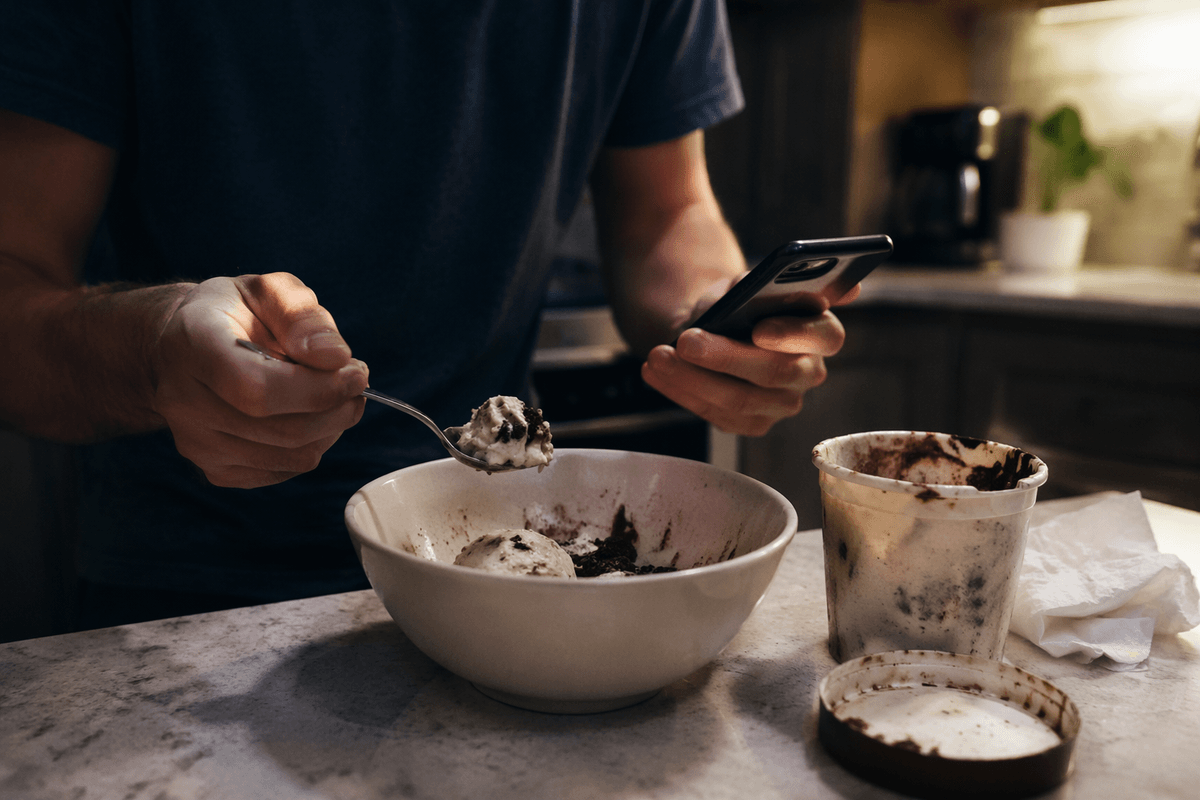
It often starts with a small, reasonable thought: one more to round it out, one more before you get back to the email, one more because the taste is finally “right.” In the moment, that logic can feel solid—even when you’re noticing you’re not truly hungry, or you’re already slightly too full.
One reason is that your brain is working with quick feedback, not the slower signals from your gut. A strong hit of salt, sugar, fat, and aroma can produce an immediate sense of relief or reward, so the next bite looks like a low-effort way to keep that feeling going. If you’ve repeated that pattern at night, during stress, or while distracted, the context itself can start to predict the reward. Then “just one more” isn’t random—it’s the brain following a learned, efficient script.
Hyper-palatable design amplifies reward-learning loops
Sometimes the first few bites feel almost louder than the rest—bright, sharp, and oddly “clean,” like they reset your attention. Then a few minutes later, the flavor starts fading, and you may find yourself chasing that exact first-hit feeling, even if your stomach is sending mixed signals.
That’s not only about hunger. Many packaged snacks are built for fast reward: a tight combination of salt or sugar with fat, plus aroma compounds that travel up into the nose as you chew. That rapid sensory payoff can drive dopamine-based learning, where your brain updates, “this is worth repeating,” before slower fullness signals (stretch and gut hormones) have much influence. When the reward arrives quickly and reliably, the cue that precedes it—opening the bag, sitting down to work, turning on a show—can start to carry its own pull.
Over time, the loop can get a little inconsistent: you might feel satisfied one night and still want more the next, because the trigger is the cue and the expected hit, not a stable need for calories.
What drives the pattern beneath the surface
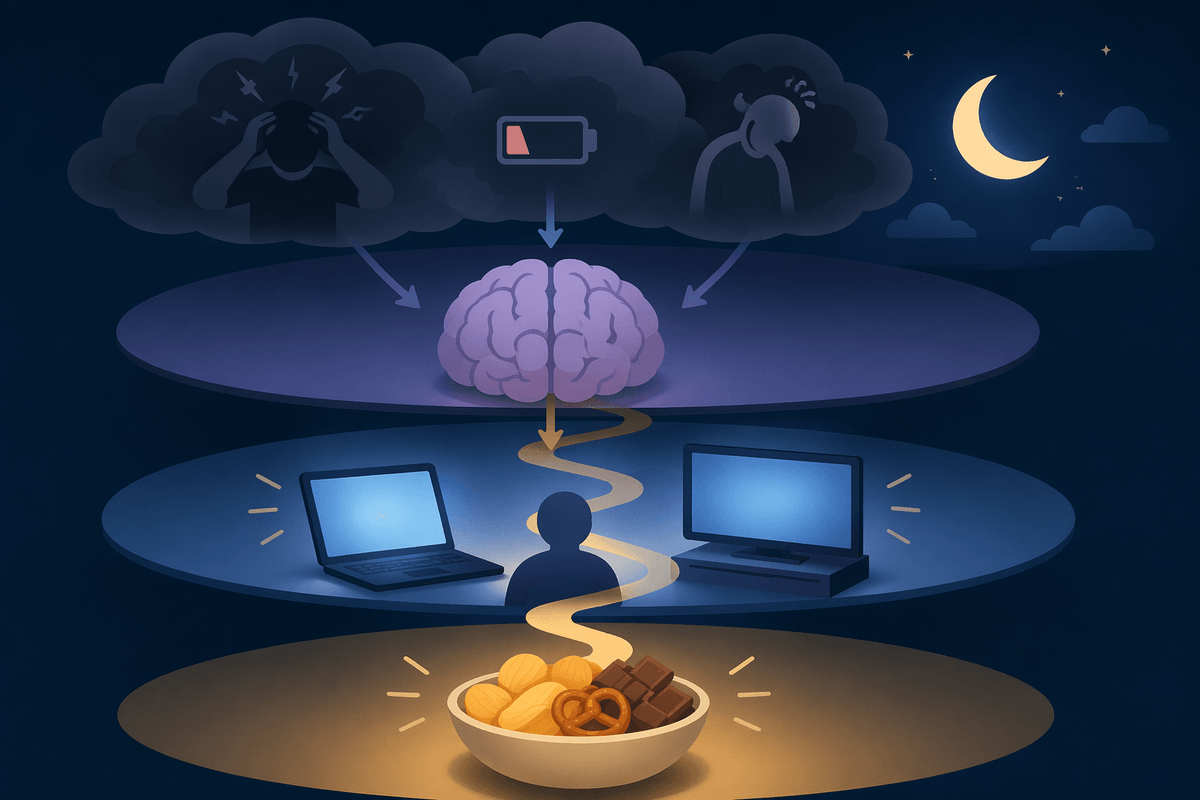
Some nights it’s less like a craving and more like a pull—your hand reaching before you’ve fully decided. That can feel inconsistent: you might be comfortably fed, yet the urge still shows up as if something is unfinished.
Underneath, a few systems can stack. Stress, mental fatigue, and low sleep can nudge the brain toward fast, reliable reward, because that’s cheaper than effortful self-control in the moment. Meanwhile, habit memory links a setting (laptop open, show on, kitchen quiet) with a specific sensory payoff. When that cue appears, the brain can “pre-load” expectation—attention narrows, and the next bite starts to look like the simplest way to complete the loop.
At the same time, body signals don’t always send one clear message. Gut fullness and satiety hormones tend to rise gradually, but highly flavored snacks can keep taste-driven motivation running even when your stomach feels only mildly interested. That mismatch is why it may be easy to misread the urge as hunger, even if what’s really driving it is prediction and relief rather than need.
Texture, sound, and speed shape intake rate
You might notice it most when you’re working: the bag keeps making small noises, and your mouth is already ready for the next bite before the last one is finished. With crunchy snacks, there’s often very little pause built in—no utensils, no plating, no natural “stop” between bites—so the pace can drift faster than you realize.
Texture and sound can act like tiny confirmations that you’re getting what you came for. A loud crunch or quick melt gives immediate sensory closure, which can make the next bite feel like a clean, low-effort repeat. When the reward is that fast, your brain doesn’t need much time to decide again; it just keeps the sequence going. That matters because fullness signals tend to lag behind intake, so a faster eating rate can mean you pass your comfortable stopping point before your body’s cues get loud enough to compete.
Sometimes you’re not tasting it as strongly anymore, yet your hand keeps moving. In that moment, it may not be hunger driving the speed so much as momentum—your attention tracking texture and rhythm more than satisfaction.
When “mindful eating” backfires into fixation
Sometimes the moment you try to slow down, the snack suddenly feels bigger in your mind than it did a minute ago. You take a deliberate bite, notice the salt and crunch, and instead of feeling satisfied, you catch yourself scanning for whether it still tastes “as good.” The experience can turn strangely effortful, like you’re doing a focus task while eating.
That can happen because attention changes the way reward is tracked. When you monitor each bite closely, your brain may start comparing it to the first-hit memory, looking for the same intensity. If the flavor naturally fades as you keep eating, that comparison can create a small sense of “not yet,” even if your stomach is starting to settle. In some cases, the checking itself becomes the loop—bite, evaluate, adjust—so stopping feels less like listening to fullness and more like ending an unfinished test.
And if you’re already slightly tense—trying to prove it’s not willpower—the extra self-monitoring can make normal wanting feel like a problem to solve. If that pattern keeps showing up, it may help to notice whether “mindful” has quietly shifted into “measuring.”
Why some people feel it more strongly
On some evenings, the pull can feel louder—like the snack “shows up” in your body before you’ve had a clear thought. Other times, the same food is easy to ignore. That inconsistency can make it tempting to label it as willpower, even when the pattern isn’t steady.
Part of the difference may be how sensitized your reward system is in that moment. Poor sleep, high stress, and mental overload can tilt the brain toward quick dopamine-linked payoff, while appetite signals (like fullness and satiety hormones) stay slower and quieter. If you’ve repeated the same cue—work screen, TV, certain time of night—the cue can start triggering expectation on its own, so the urge arrives before hunger does.
Some people also seem more reactive to sensory intensity or more prone to habit loops, which can make “just one more” feel unusually persuasive. If the pull keeps escalating or starts feeling hard to interrupt, that’s a useful moment to take seriously rather than argue with.